


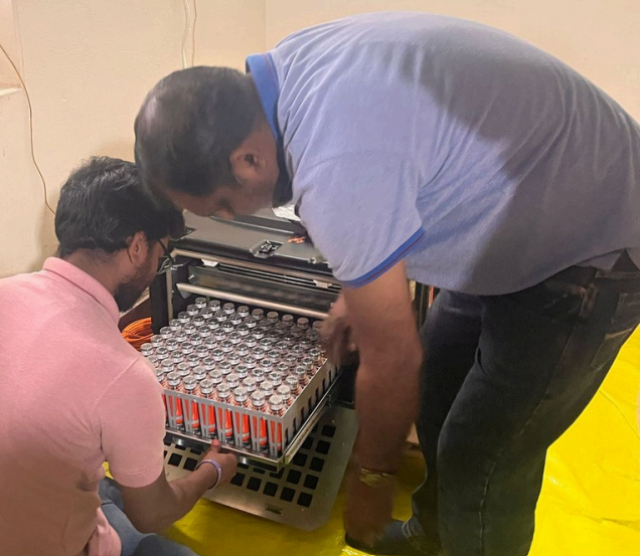
Authored by Sam Moharir, STRYDE
Having enabled more than 250 onshore oil and gas exploration projects worldwide, the STRYDE nodal seismic acquisition system has already transformed hydrocarbon development in diverse operating environments.
Today, STRYDE’s agile, cable-free technology is well positioned to support the next phase of India’s oil and gas growth - delivering higher-quality subsurface imaging in less time, with fewer resources and at significantly lower cost.
This article has been featured in DEW Journal, click here to download it.
A Renewed Push for Domestic Exploration
India is entering a renewed phase of hydrocarbon exploration. Through the Hydrocarbon Exploration and Licensing Policy (HELP) and the Open Acreage Licensing Programme (OALP), the government continues to open new blocks and attract fresh investment, while national initiatives are directly funding seismic acquisition to accelerate discoveries and reduce import dependence.
Exploration activity is increasing across both mature basins and frontier areas, with national operators such as ONGC and Oil India intensifying onshore and offshore programmes. As the scale and pace of exploration grows, the efficiency and effectiveness of seismic acquisition will be critical to success.
Moving Beyond the Limits of Traditional Cabled Seismic
Historically, land seismic acquisition in India has relied on large-scale cabled systems, requiring thousands of kilometres of cables, extensive line preparation and large field crews. While proven and familiar, these systems drive high operational costs, complex logistics and long acquisition timelines.
This reliance is rooted as much in legacy investment as in technology. Decades of experience with cabled spreads have shaped tender specifications, workflows and training, reinforced by recent procurements of new-generation cable-based systems. For many operators, cables remain the perceived low-risk option for delivering predictable data quality.
However, as India’s exploration ambitions scale under tighter timelines, stricter HSE expectations and increasing sensitivity to land access and environmental footprint, the limitations of cable-based acquisition are becoming harder to ignore, especially given the need to reduce costs to maintain or reduce exploration costs.
India’s Operating Reality Exposes Cable Constraints
India’s most prospective basins - including Krishna-Godavari, Cambay, Rajasthan, Assam-Arakan Fold Belt and Cauvery - span highly varied and challenging surface environments. Surveys frequently cross farmland, forests, deserts, wetlands, foothills and densely populated areas.
Land access is often fragmented across many small landholders, permitting is time-critical, and the monsoon season compresses operational windows while stressing logistics. In these conditions, dense field cabling becomes vulnerable to damage, weather-related wear and tear, and repeated downtime - often becoming the dominant driver of cost and delay.
In addition, traditional cabled systems require large, heavy digitiser units powered by hundreds of batteries distributed across the spread. Any cable damage can result in significant lost production time, while system weight and complexity limit receiver density, with station spacings often extending to 45 m or more.
A Step-Change with Cable-Free Nodal Seismic
Nodal seismic systems remove thousands of kilometres of vulnerable field cable and significantly reduce the daily labour associated with laying, monitoring, repairing and retrieving it. The result is a simpler, faster and safer field workflow with fewer vehicles, smaller crews and a much lower surface footprint - key advantages in cultivated and environmentally sensitive areas.
STRYDE’s nodal system significantly reduces personnel requirements, simplifies logistics and minimises line preparation, representing a step-change in how land seismic surveys can be executed in India.
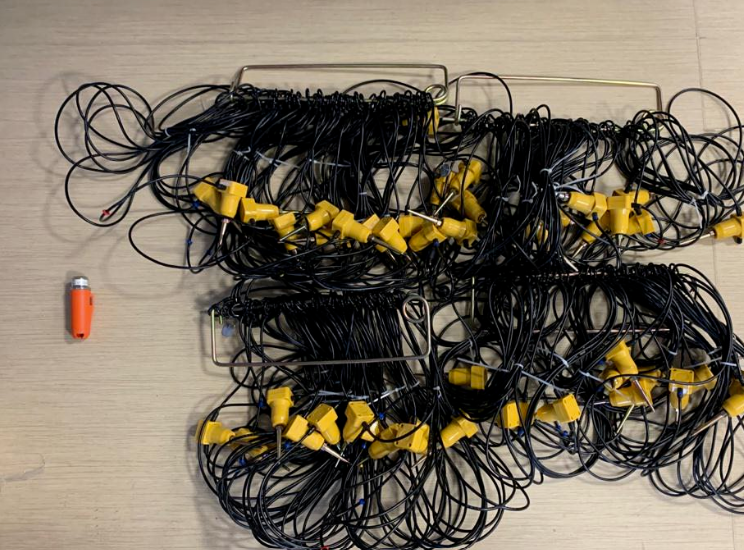
The operational advantages of STRYDE’s seismic system were recently demonstrated on a landmark project with CCED in Oman - the world’s largest 3D nodal seismic survey to date. Covering more than 29,000 km² and deploying approximately 165,000 channels, the project proved the scalability and efficiency of large-scale cable-free acquisition.
Commenting on the impact of STRYDE’s nodal technology, Eskil Jersing, Exploration and Appraisal Director at CCED, said:
“This nodal technology delivers multiple benefits, including significantly lower acquisition costs, a reduced HSE footprint - cutting field crews from around 600 to approximately 220 and vehicles from 160 to about 40 - and improved access across challenging sabkha and dune environments, all while maintaining high-quality seismic data.”
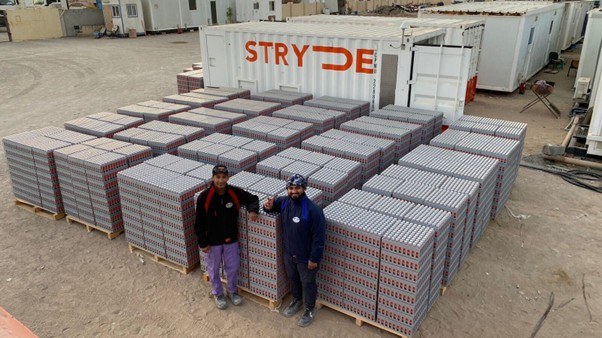
Lightweight, easy-to-deploy nodes are proven to allow more equipment to be rolled out faster, enabling more efficient shooting strategies and accelerated project timelines. Where source productivity or terrain becomes the limiting factor, receiver density can be increased to reduce the number of source points required - giving survey designers greater flexibility to optimise geometry for both speed and imaging quality.
Unlocking Value Across Mature and Frontier Basins
This flexibility is particularly valuable in India’s diverse exploration portfolio. In mature basins, high-density nodal geometries can sharpen imaging and reveal subtle stratigraphic traps overlooked by legacy data. In frontier acreage under OALP, improved velocity models and structural clarity early in the licence cycle help de-risk exploration and accelerate the path to drill-ready prospects.
In both scenarios, faster, less intrusive operations allow operators to maximise short weather windows and move more quickly from seismic acquisition to interpretation and drilling decisions.
STRYDE’s nodal solution and integrated services enable seismic data to be acquired and delivered at a far faster rate than traditional cabled approaches. At scale, this translates into broader operational efficiencies, reduced environmental impact and improved capital efficiency across exploration programmes.
As India looks to strengthen energy security and accelerate domestic resource development, cable-free nodal seismic offers a clear path forward - unlocking larger, denser surveys, shortening turnaround times and supporting a more efficient and sustainable future for the country’s oil and gas industry.