Chat GPT Image Apr 20 2026 12 25 28 PM
Eguide2

Applied geophysics in mineral exploration

Methods, workflows, and strategic value
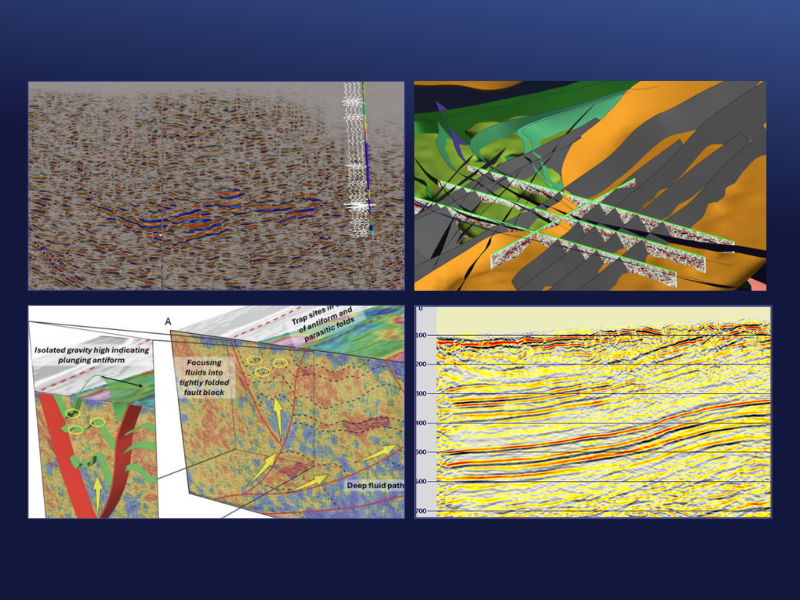
Mining seismic

How geophysics sees beneath the surface: a practical guide for mineral exploration


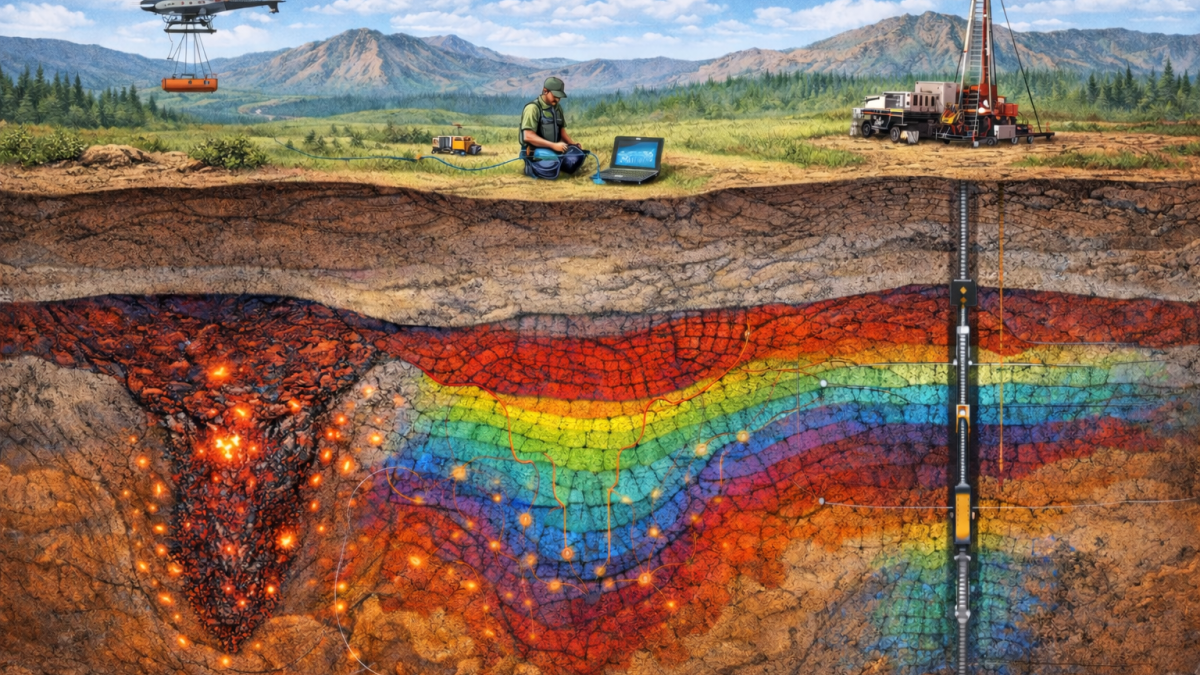
At the most basic level, geophysical exploration is simply using physics to “see” into the ground without digging. It’s the subsurface equivalent of medical imaging, different physical properties reveal different geological features.

What geophysics measures:

  • Rocks differ in density, magnetic susceptibility, electrical conductivity, radioactivity, elasticity, and other physical properties.
  • Geophysical instruments measure these contrasts from the surface, the air, or downhole.
  • Anomalies in these measurements often correspond to changes in lithology, structure, or mineralisation.

The power of geophysics

Why it works
  • Ore bodies often have distinct physical signatures compared to surrounding rocks.
    • Massive sulphides → highly conductive
    • Iron formations → strongly magnetic
    • Dense intrusions → gravity highs
  • These contrasts allow explorers to map geology even when it’s buried under soil, sand, or cover.
Why it works to What it can reveal
What it can reveal
  • Geological boundaries (contacts between rock types)
  • Faults, folds, and structural trends that control mineralisation
  • Alteration zones associated with hydrothermal systems
  • Depth to bedrock and regolith architecture
  • Potential ore bodies or favourable host rocks.

Geophysics and exploration

How geophysics fits into exploration
  • Used early in exploration to map broad geological patterns
  • Guides geochemical sampling and structural mapping
  • Refines drill targets by highlighting anomalies worth testing
  • Supports 3D modelling and integrated mineral systems analysis.
How geophysics fits into exploration to Role of geophysics in mineral exploration
Role of geophysics in mineral exploration
  • Reduces exploration risk by imaging subsurface geology before drilling
  • Helps define structural frameworks, lithological boundaries, and alteration zones that control mineralisation
  • Provides cost‑effective coverage over large areas, especially in terrains with poor outcrop.

Overview of geophysical methods

Airborne investigation techniques

  • Magnetics: Maps lithology, structure, intrusions, and magnetite alteration; essential for greenstone belts and iron formations.
  • Radiometrics: Identifies surface geochemistry, regolith patterns, and potassium/uranium/thorium variations linked to alteration.
  • Airborne EM (AEM): Detects conductive bodies such as massive sulphides, clays, salinity, and groundwater pathways.
  • Gravity & Gravity Gradiometry: Highlights density contrasts; excellent for mapping basin architecture, intrusions, and IOCG systems.
Airborne investigation techniques

Ground investigation techniques

  • Ground EM (TEM, FLEM, MLEM): Detection of conductive ore bodies; critical for nickel sulphides and VMS systems.
  • IP/Resistivity: Maps disseminated sulphides and alteration halos; widely used in porphyry and epithermal systems.
  • Seismic: Increasingly used for deep targeting; resolves faults, stratigraphy, and ore‑hosting geometries at depth.
  • Magnetotellurics (MT): Provides deep crustal conductivity structure; useful for mapping fertile corridors and lithospheric architecture.
  • Gravity Surveys: Refines density models at prospect scale; supports 3D inversion and drill targeting.
Ground investigation techniques

Strengths and limitations to consider

Strengths of geophysical methods
  • Covers large areas quickly and cost‑effectively
  • Provides continuous data rather than point samples
  • Reduces drilling risk by refining targets before expensive holes are drilled
  • Works in terrains with poor outcrop or deep weathering.
Strengths of geophysical methods to Limitations to keep in mind
Limitations to keep in mind
  • Geophysics does not directly “see” ore; it detects physical contrasts, which must be interpreted
  • Multiple geological scenarios can produce similar anomalies
  • Always requires geological context, ground truthing, and drilling to confirm interpretations.
data integration

Integration with geological and geochemical data

Value comes from integration, not standalone datasets. The benefits of integrating geophysical data with geological and geochemical data include:
  • Enhances geological mapping by tying geophysical signatures to known lithologies and structures
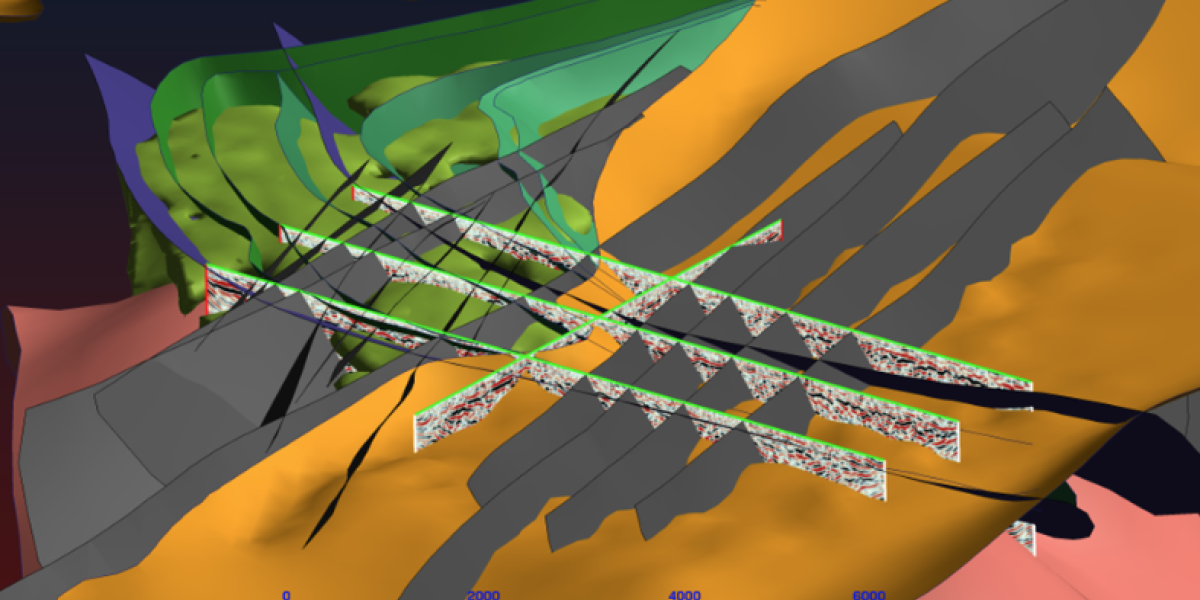
  • Supports 3D modelling workflows that combine drillhole data, surface mapping, and geophysical inversions
  • Helps vector toward mineralisation by identifying alteration footprints and structural traps
3 D Seismic Gold exploration

A summarized workflow example for gold exploration in Australia

An example workflow

STRYDE D

1. Understand

Start with a desktop study to understand regional geology, structures, historical work, and deposit models.

STRYDE D

2. Identify

Use regional geophysics (magnetics, gravity, radiometrics, AEM/MT) to identify major structural corridors and favourable lithologies.

STRYDE D

3. Prospect

Move to prospect scale surveys (high resolution magnetics, ground gravity) to resolve subtle structures and refine targets under cover.

STRYDE D

4. Target

Apply target focused methods (IP/resistivity, EM, seismic) to detect alteration halos, sulphides, and structural features linked to gold systems.

STRYDE D

5. Model

Integrate geophysics with geochemistry, regolith mapping, and geology to rank targets and build 3D models.

STRYDE D

6. Test

Drill test the highest priority targets and use downhole geophysics to refine geometry and extend mineralised zones.

STRYDE D

7. Repeat

Iterate the process - each dataset informs the next step, improving confidence and reducing drilling risk.

How technology is transforming mineral exploration

Advances in technology and interpretation
  • Improved sensor sensitivity and lower noise floors enable detection of subtler anomalies
  • UAV‑based geophysics offers flexible, low‑cost surveys in difficult terrain
  • Machine learning and automated inversion accelerate interpretation and reduce subjectivity
  • 3D and 4D geophysical modelling provides dynamic understanding of mineral systems through time
Advances in technology and interpretation to Strategic value in exploration programs
Strategic value in exploration programs
  • Guides drilling by prioritising targets with favourable geophysical signatures
  • Reduces cost per discovery by focusing effort on the most prospective areas
  • Supports greenfields exploration where geology is poorly exposed
  • Provides defensible, data‑rich justification for exploration decisions and investment.

Choosing the right geophysical method: strengths and limitations explained

Strengths

  • Covers large areas quickly and cheaply, making it ideal for regional exploration
  • Excellent for mapping faults, shear zones, dykes, and lithological boundaries
  • Detects magnetite‑rich rocks and alteration, which can highlight mineralising systems
  • Works well under deep cover where surface mapping and geochemistry struggle
  • Modern low‑altitude surveys provide high spatial detail
  • Produces stable, repeatable data that can be reprocessed and modelled in 2D or 3D
  • Often supported by extensive, high‑quality government datasets

Limitations

  • Aerial magnetics only responds to magnetic contrasts, so non‑magnetic geology or gold systems (as an example) without magnetite alteration may show little to no signal
  • Depth information is ambiguous - strong shallow sources can hide deeper ones, and weak deep sources may be undetectable
  • Magnetic anomalies are non‑unique, meaning multiple geological explanations can fit the same data
  • Weathering and regolith can suppress or distort magnetic signatures
  • Survey resolution depends on line spacing and altitude, so coarse regional data may miss subtle structures
  • Cultural features such as powerlines, fences, and infrastructure can introduce noise and false anomalies
  • Magnetic remanence can complicate interpretation by altering anomaly shapes and directions
  • Magnetics cannot directly detect mineralisation - only structure, lithology, and alteration that may be associated with it.

Strength's

  • Detects density contrasts directly, making it excellent for mapping intrusions, alteration zones, and basin architecture
  • Not affected by magnetic remanence or complex magnetic overprints, so it provides clean structural and lithological information
  • Sensitive to deep, large‑scale features, giving insight into crustal architecture and major controlling structures
  • Performs well under thick cover where other methods lose effectiveness
  • Supports reliable 2D and 3D modelling of subsurface geometry and density distribution
  • Highly repeatable and stable, integrating smoothly with magnetics, seismic, and geology
  • Scales from regional reconnaissance to detailed prospect‑scale targeting.

Limitations

  • Gravity only responds to density contrasts, so geology without meaningful density differences may produce no anomaly
  • Subtle density variations can be difficult to detect, and anomalies are non‑unique, meaning multiple geological models can fit the same data
  • Results can be affected by terrain, cultural noise, and elevation errors, all of which require careful correction
  • Ground surveys can be slow and labour‑intensive, especially in remote or rugged areas
  • Gravity highlights geometry and density, not mineralisation itself, so it must be integrated with other datasets for effective targeting.

Strengths

  • Reaches exceptional depths, imaging conductivity structure from near‑surface to the lower crust and mantle.
  • Maps major faults, shear zones, and deep architecture that control mineral systems such as IOCG, porphyry, and sediment‑hosted copper.
  • Sensitive to conductive features including alteration zones, graphitic horizons, saline fluids, and sulphide‑bearing structures.
  • Performs well under thick cover, where magnetics, radiometrics, and geochemistry lose effectiveness.
  • Passive method with no active source, enabling large‑area surveys at relatively low cost.
  • Complements other datasets by adding electrical conductivity to geological models.
  • Supports 2D and 3D inversion, producing robust images of subsurface conductivity distribution.

Limitations

  • Measures conductivity only, so resistive targets or geology with weak conductivity contrasts may not be detectable.
  • Susceptible to cultural noise from powerlines, pipelines, and infrastructure, which can distort data.
  • Near‑surface conductive layers (e.g., clays, saline groundwater) can mask deeper features.
  • Inversion results are non‑unique, requiring geological constraints and integration with other datasets.
  • Field acquisition can be slow, especially for dense station spacing or remote terrain.
  • Resolution decreases with depth—deep features are visible but often broad and diffuse.
  • Interpretation requires specialist expertise, and results can be misread without strong geological context.

Strengths

  • Very sensitive to conductivity, making it effective for detecting sulphides, graphitic units, clays, and conductive alteration
  • Capable of directly detecting conductive mineralisation, especially massive sulphides and some copper–nickel systems
  • Works well under cover, with airborne, ground, and downhole options covering everything from regional mapping to detailed targeting
  • Can provide useful information on the geometry of conductors, including depth, dip, and thickness
  • Complements other geophysics by adding electrical conductivity to the geological model.

Limitations

  • Only responds to conductive contrasts, so resistive mineralisation or weakly conductive geology may be invisible
  • Conductive cover (clays, saline groundwater) can dominate the signal and obscure deeper targets
  • Penetration depth is reduced in highly conductive terrains
  • Susceptible to cultural noise from powerlines, fences, and infrastructure
  • Interpretation is non‑unique and often requires specialist processing and modelling
  • Ground EM can be slow and labour‑intensive, while airborne EM is more expensive.

Strengths

  • Very sensitive to disseminated sulphides, making it ideal for detecting pyrite‑rich or sulphide‑altered zones
  • Helps map alteration halos using chargeability and resistivity together
  • Can reach moderate to good depths, depending on array and transmitter power
  • Provides useful information on the geometry of chargeable bodies
  • Works effectively under cover where surface geochemistry is muted
  • Flexible survey configurations allow tailoring to target size and terrain.

Limitations

  • Responds to chargeability, not ore directly - clays, graphite, and non‑economic sulphides can all produce anomalies
  • Conductive cover (clays, saline groundwater) can distort or mask deeper responses
  • Interpretation is non‑unique, requiring geological context and supporting datasets
  • Resolution decreases with depth, making deep anomalies broad and diffuse
  • Susceptible to cultural noise from powerlines and infrastructure
  • Ground acquisition is labour‑intensive and slow, especially in rugged terrain.

Strengths

  • Delivers high‑resolution images of subsurface structure, mapping faults, shear zones, stratigraphy, and intrusive contacts with exceptional clarity
  • Provides deep penetration, imaging features from near‑surface to several kilometres
  • Directly captures true structural geometry rather than indirect physical contrasts
  • Modern acquisition and processing make it effective even in hard‑rock terrains
  • Supports detailed 2D and 3D geological modelling, revealing features often invisible to other geophysical methods.

Limitations

  • Expensive compared with most other geophysical techniques, especially for 3D surveys
  • Logistically demanding, requiring access for source and receiver lines
  • Image quality can suffer in heterogeneous or strongly scattering rocks
  • Not directly sensitive to mineralisation—seismic maps structure, not ore
  • Requires complex processing and specialist interpretation expertise.

Strengths

  • Lower cost than reflection seismic methods as no artificial energy source is required
  • Capable of covering large areas efficiently, making it suitable for regional-scale geological mapping
  • Provides useful regional context through velocity models that highlight major structures
  • Offers insights comparable to potential field methods, helping define large-scale subsurface architecture rather than detailed targets.

Limitations

  • Much lower resolution than reflection seismic
  • Limited to low-frequency energy (<8 Hz), resulting in long wavelengths that cannot resolve small-scale features
  • Ineffective at detecting most mineral systems because wavelengths are significantly larger than the target features
  • Produces broad, non-unique interpretations where multiple geological scenarios can explain the same result
  • Results are not directly comparable to reflection seismic, which is designed to answer specific geological questions
  • Relies on naturally occurring seismic energy, which may not always be present or consistent
  • Requires long acquisition times, typically ranging from months to years.

As targets get deeper, seismic stands apart

In the end, geophysics is not about choosing a single method, it’s about choosing the right tools for the right question. Airborne surveys, EM, gravity, and IP each play a critical role in building the exploration picture, helping reduce uncertainty step by step. But as exploration pushes deeper, targets become more structurally complex, and the cost of drilling continues to rise, one method increasingly stands apart – reflection seismic.

Reflection seismic is where interpretation shifts from inference to direct imaging.

While most geophysical techniques respond to physical contrasts that suggest geology, seismic reveals the architecture itself, faults, stratigraphy, and the structural frameworks that control mineral systems. It provides the clarity needed to understand not just where a target might be, but why it exists and how it is formed. In the context of modern exploration where drilling decisions can hundreds of thousand of dollars, that investment is often justified by the reduction in uncertainty and the ability to target with precision.

The most successful exploration programs are those that integrate multiple datasets, but increasingly, they are anchored by seismic.

Got a question or want more information?

Fill in this form and a member of our team will be in touch soon!