



CCUS
Real-world Full Waveform Inversion (FWI) for complex land data
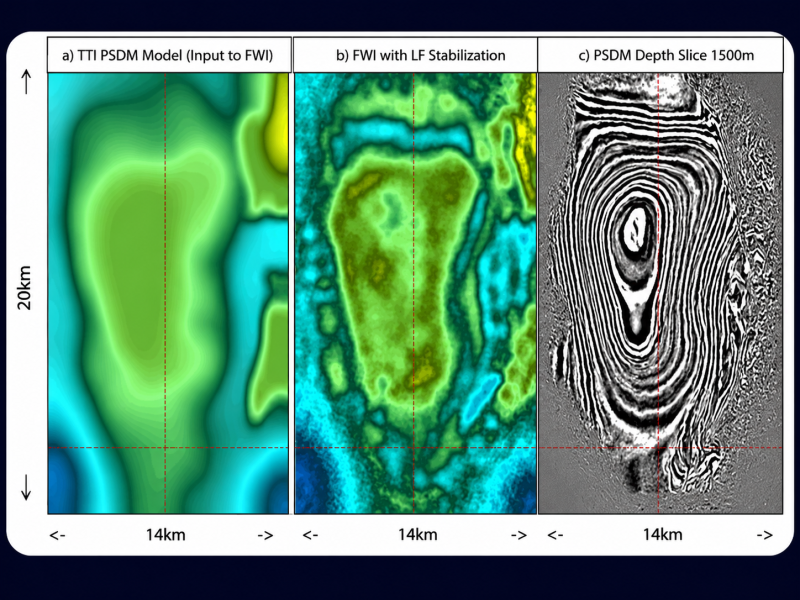
A technical paper (delivered at EAGE 2026 in Aberdeen) showcased how FWI can be successfully applied to a sparse, highly irregular onshore seismic dataset affected by challenging ambient and acquisition-related noise, acquired for CO₂ storage evaluation in Denmark.
The 2025 survey used STRYDE nodes and a 5–100 Hz Vibroseis sweep to acquire the data. Access restrictions around towns, industrial areas and farmland resulted in uneven source and receiver coverage, while low-frequency ambient and cultural noise associated with the onshore survey environment obscured much of the refraction energy below 12 Hz, limiting its suitability for conventional FWI.
To address these challenges, realtimeseismic developed a customised velocity-model-building workflow combining detailed diving-wave tomography, 5D interpolation, reflection tomography and synthetic first-break data. This tailored approach stabilised the inversion, reduced the risk of cycle skipping and produced a velocity model with improved vertical and lateral resolution.
The resulting model showed stronger alignment with available well-velocity information and provided a more accurate foundation for seismic imaging and CO₂ storage evaluation.
The world's smallest and most affordable seismic sensors