
Oil and gas
Technical paper
In this paper, experts from King Abdullah University of Science and Technology (KAUST) and Shearwater GeoServices prove that SWD data - traditionally complex and expensive to handle- can become a far more accessible, economical, and operationally practical solution for real-time subsurface imaging during drilling.
Seismic-while-drilling (SWD) offers operators a cost-effective way to “listen” to the subsurface by using naturally generated drill-bit noise as a seismic source. However, because this source is highly erratic and its signature is unknown, extracting high-quality seismic information from SWD recordings has traditionally been a significant challenge.
In this study, experts introduce a practical and scalable workflow that applies multi-dimensional deconvolution (MDD) to SWD data to derive a high-fidelity reflection response from virtual subsurface sources to surface receivers (STRYDE nodes) - free from surface-related multiples.
A core innovation of their approach is a robust method for estimating the direct arrival using a particle swarm optimization algorithm, which automatically refines initial traveltime estimates by maximizing energy across flattened and stacked seismic traces. To keep the MDD computationally efficient, the adopted a proven strategy from seismic interferometry: processing the continuous SWD stream in time segments, computing auto- and cross-correlations, and stacking the resulting correlograms. These waveforms then serve as the input to MDD.
The workflow has been validated extensively:
Acoustic synthetic models show clear improvements in virtual shot gathers and final images over standard correlation-based interferometric redatuming.
Elastic modelling tests further confirm the method’s robustness.
Field data application demonstrates real-world effectiveness and operational feasibility.
Overall, the results highlight a powerful, economical, and field-ready solution for turning challenging SWD recordings into actionable subsurface insights - unlocking greater value from existing drilling operations.

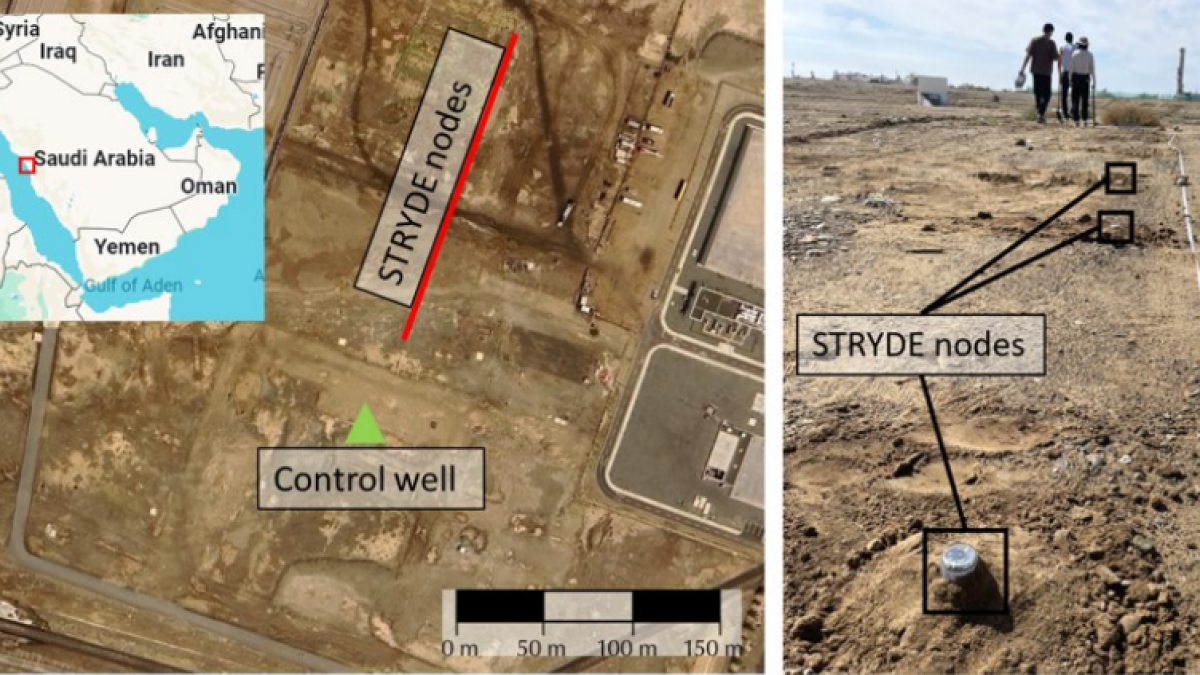
Ultra-lightweight STRYDE seismic nodes were deployed to record high-quality seismic data during drilling operations. Using STRYDE’s low-cost, high-capacity data harvesting systems, the team efficiently captured and managed the large volumes of continuous data generated while drilling.
The study demonstrated that nimble seismic receivers, when combined with innovative multi-dimensional deconvolution (MDD) techniques, can significantly enhance image quality while reducing both acquisition and processing costs.
This proves that SWD data - traditionally complex and expensive to handle- can become a far more accessible, economical, and operationally practical solution for real-time subsurface imaging during drilling.

