Civil engineering
Seismic risk
Technical paper
Published in Journal of Applied Geophysics, Volume 247, 2026, 106081 by researchers from ETH Zurich and RWTH Aachen (T.Kiers, C. Schmelzbach, H. Maurer, F. Amann, J.Robertsson).
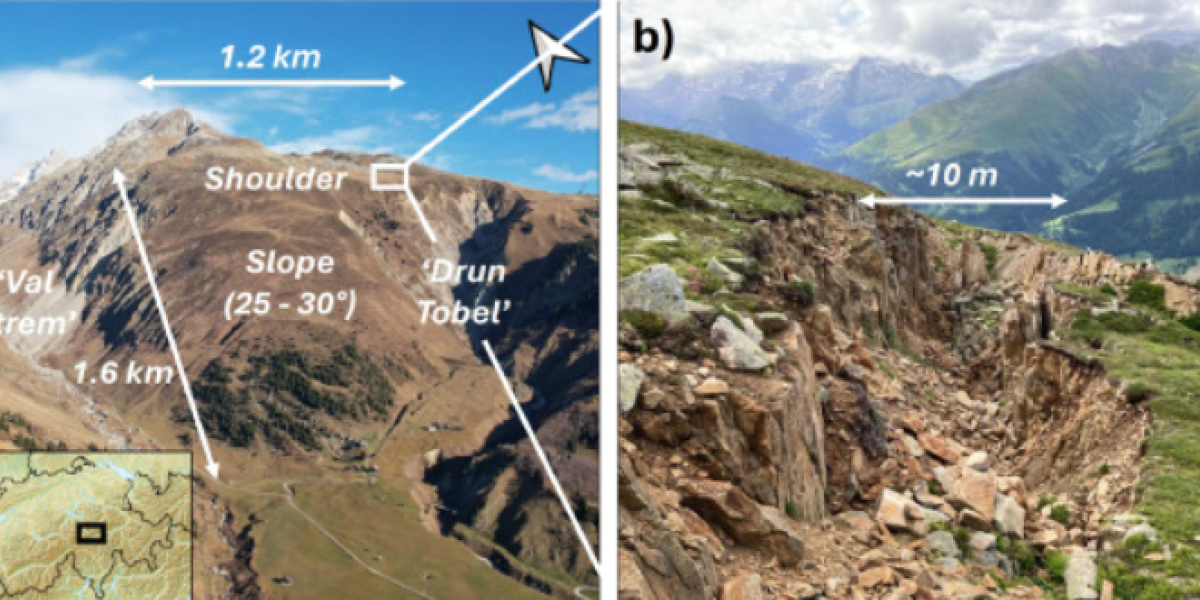
Understanding the internal structure and geometry of large-scale gravitational slope instabilities is crucial for hazard assessment and risk mitigation in mountainous regions. This study presents a high-resolution 2D and 3D seismic first-arrival traveltime tomography analysis of the Cuolm da Vi (CdV) slope instability, one of the largest active mass movements in the Alps. To achieve this, researchers conducted an extensive seismic survey, deploying over 1000 autonomous nodes across a 0.7 km area and acquiring data from 144 controlled-source shots.
The resulting 2D and 3D tomographic models reveal significant subsurface heterogeneities, including extensive low-velocity zones up to depths of 200 metres, indicative of severe rock mass disintegration. Additionally, strong lateral velocity variations persist throughout the unstable zone, further corroborating its structural complexity.
Their findings align with previous studies that suggest toppling as the dominant deformation mechanism. The comparison between 2D and 3D velocity models highlights the critical role of out-of-plane effects, such as observed lateral ray bending, emphasizing the importance of 3D imaging for accurate characterization of complex instability structures.
The 2D and 3D velocity models provide important constraints for estimating the total unstable rock volume and serve as a foundation for future geotechnical analyses and hazard assessments. This study also demonstrates the feasibility and effectiveness of large-scale nodal seismic deployments in alpine terrains, paving the way for further applications in monitoring and characterizing deep-seated slope instabilities.