


Oil and gas
Technical presentation
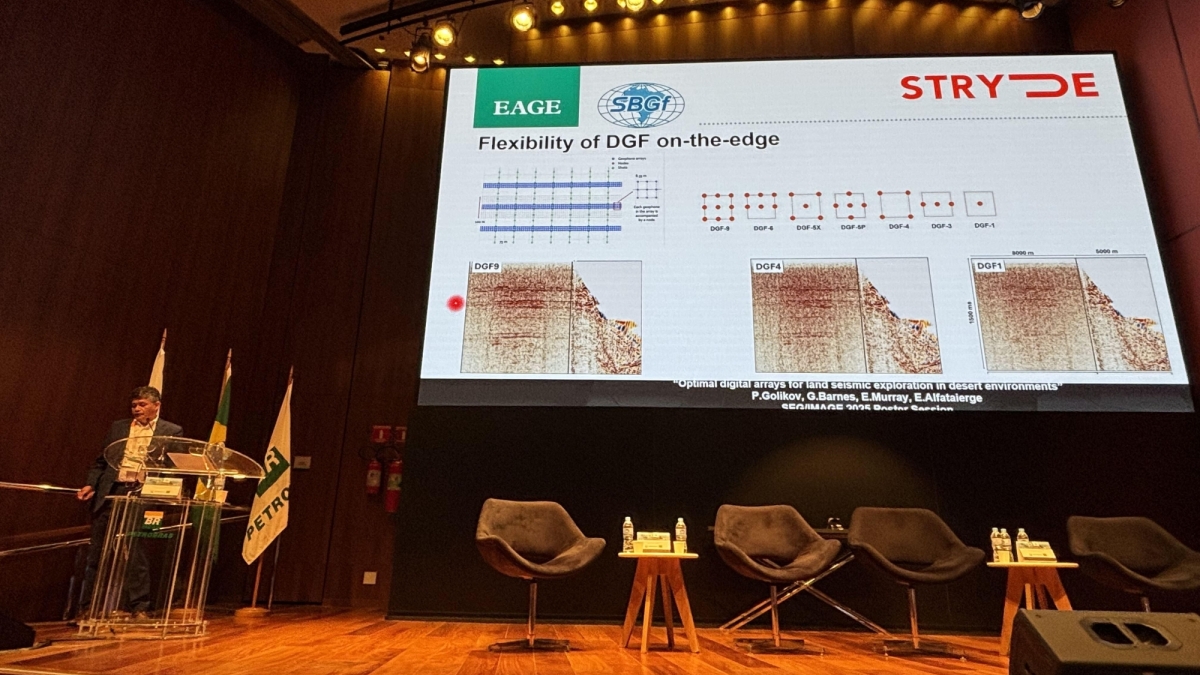
Delivered by STRYDE Geoscience Advisor, José Olaya at the 2026 SBGf/EAGE workshop on data processing in Rio, Brazil.
Traditional geophone arrays suppress noise and produce cleaner-looking field records, but stacking the array elements can also conceal problems, including high-frequency loss, faulty elements and phase instability, that cannot be corrected once the data has been stacked. Single-sensor nodes capture noisier raw records, but their high spatial sampling preserves more of the original wavefield and gives processing teams greater control over how variable noise is identified and attenuated.
During the presentation, José and examined the advantages and limitations of both approaches and introduce Digital Group Forming (DGF) as an intermediate solution. DGF can reduce single-sensor data volumes to a size comparable with conventional array systems while retaining the flexibility to condition the data before forming the array stack.